Third and last chapter of the feature prepared by our reader Emmanuel, a journey through some unusual statistics ahead of the World Cup, which is about to begin.

In this last episode, after focusing rather at confederation level so far, we will be looking at individual referees.
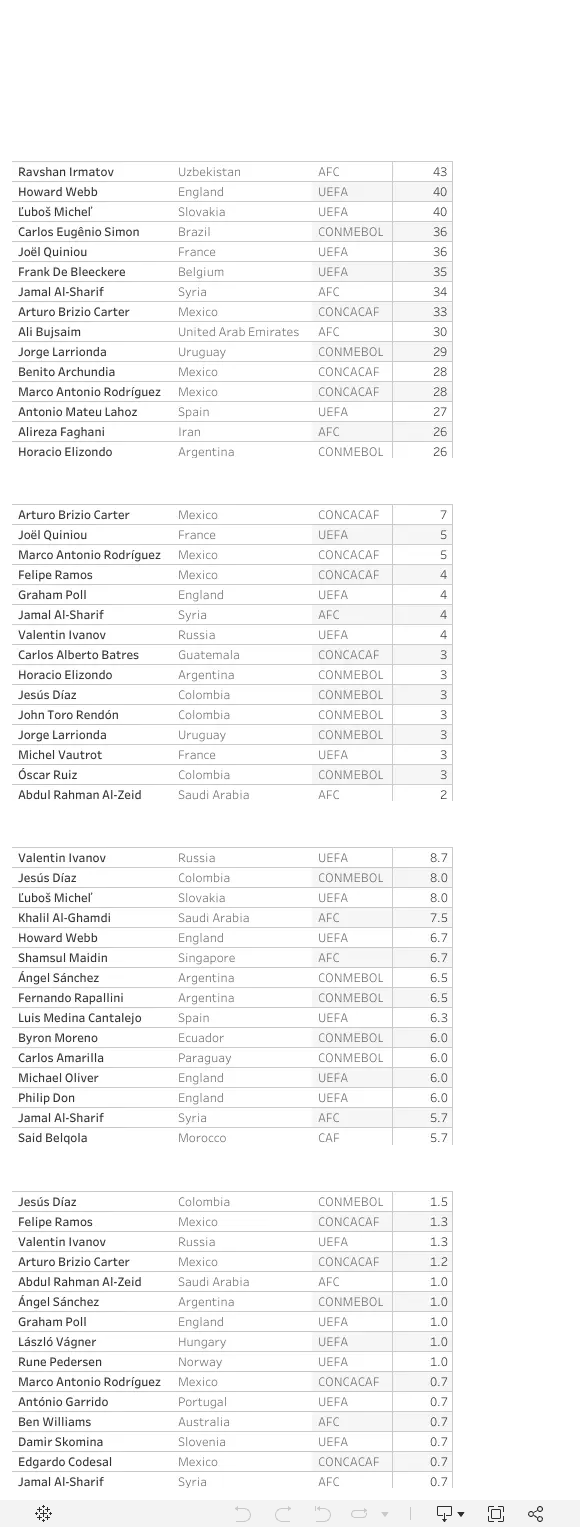
While the table on most yellow cards is largely affected by the number of games handled, in the red cards area we see more interesting patterns. For instance, a lot of referees from Mexico and Colombia are in the top spots, which confirms a tradition of strict law enforcers among officials from those countries. Referees from Argentina also rank pretty high in terms of red cards, while no Brazilian official has never issued more than one red card at World Cups.
When looking at cards per game, I decided to filter and only consider referees with at least two games at World Cup, otherwise the ranking would be too affected by those who had a particularly challenging game in their only appearance, such as A. López Nieto and J. Wegereef in 2002. Amongst the highest yellow cards per game, we can mostly find referees from the 2002, 2006 and 2010 editions where the trend was to have more cautions than at the other tournaments. F. Rapallini and M. Oliver are the only exceptions among the most recent officials that rank in the top 15. As for red cards, there are 4 referees with at least two games that had on average more red cards than games. The most surprising one is A. Brizio Carter that managed to send off 7 players in only 6 games between 1994 and 1998, of which 6 were straight red cards and one was a second yellow. The others are another Mexican, F. Ramos Rizo, appearing in 2002, Russian V. Ivanov in 2006 and J. Díaz from Colombia in 1986.
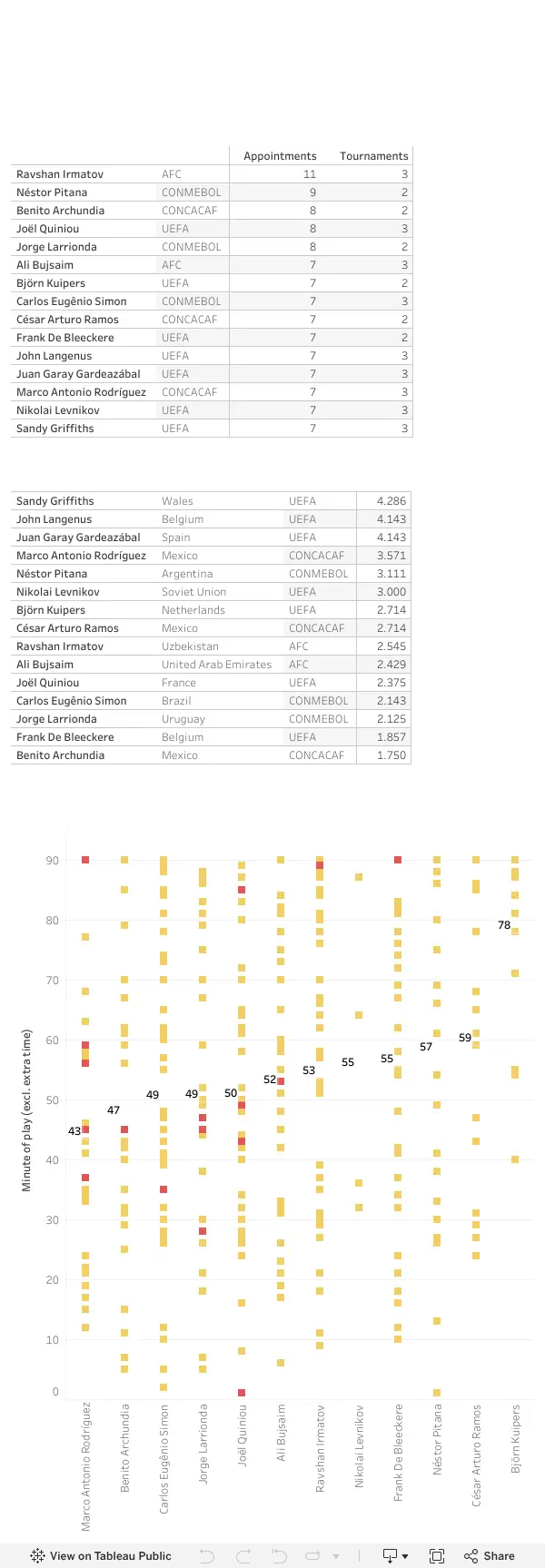
Let’s now move on to the most assigned main referees, and you will find below a list including the 11 officials with at least 7 appointments at World Cup. No secret that R. Irmatov is leading the ranking, having participated to 3 World Cups with 11 games, but I also find remarkable that N. Pitana managed to get 9 games in only two participations, with B. Archundia and J. Larrionda following closely with 8. The only UEFA referee that reached the 8 games bar was the Frenchman J. Quiniou, selected in 1986, 1990 and 1994.
Looking at active officials, C. Ramos Palazuelos will certainly be trying to rise through the ranks at the upcoming World Cup. He might hit the 10 games bar if he manages to get 3 appointments and could even dream of reaching his Uzbek colleague at the top if he got 4 games.
We should also mention some names that might be less known by all of us. My analysis has frequently focused on cards, and for this reason all editions before 1970 have been excluded, since cards were only introduced in 1970 at World Cup. Well, among the referees with at least 7 appointments we have J. Langenus from Belgium, whistling in the first three World Cup editions (1930, 1934, 1938), J. Garay Gardeazábal (Spain), appearing in 1958, 1962 and 1966, and Welsh S. Griffiths, appointed in 1950, 1954 and 1958.
The same officials are at the top in the next table, comparing average goals per game with the same pool of referees. We can clearly see that there were many more goals back in the earliest editions. After them, M. Rodríguez follows in the ranking with 3,5 goals per game on average, but the unpredictable 8 goals of the 2014 Brazil vs Germany semi-final is a huge factor to keep into account.
The following plot at the end of this section allows you to track all cards given by these referees. By pointing the cursor on the yellow and red squares you will be able to see which game, minute and player they were given. Kuipers’s statistics are the most surprising: he never showed any yellow card before minute 40 in all his 7 games, and for this reason has a very late average card minute.
The next table looks at what stands on the other side of the cards when they are shown, players and teams. While Mascherano leads the table for the most cautions (7 in 20 games played), Rigobert Song, from Cameroon, shares with none other than Zinedine Zidane the unenviable record of being the only two players that have been sent off twice at World Cup! The former in 1994 against Brazil and 1998 against Chile, the latter in 1998 against Saudi Arabia and in… well, I am sure you all remember the other one!
I find even more intriguing to look at those tables that display the average cards by team. While the “all teams” are mostly populated by countries that participated to few tournaments and specifically those where card averages were high – as example, Angola, Trinidad and Tobago, Togo and “Serbia and Montenegro” under this name all participated to 2006 only – when looking at teams that have participated to multiple tournaments – I set the bar at 20 games minimum – we see that Mexico tops the yellow card ranking while Portugal the red card one, closely followed by Italy.
Would you have guessed Switzerland and South Korea would be that high in the average yellow cards per game ranking?
The averages might look low, but they consider all games from 1994 onwards. I chose this year to start, as it would have generated lots of duplicate countries if the count started previously, with many geopolitical changes happening in those years, such as the dissolution of former Yugoslavia, Soviet Union and the reunification of East and West Germany.
Note: I would like to underline that the database used for this analysis only considered cards issued to players on the pitch. Cards given to players on the bench were not included.

Still focusing on players, the next block explores disciplinary management across different roles, dividing between goalkeepers, defenders, midfielders and forwards.
The pattern with yellow cards is relatively stable. The proportion of cautions to strikers has been decreasing with the years, but nothing significant. Red cards are better to be shown as absolute values, rather than % of total, since they are much less, especially in recent years. While we had 3 defenders and a striker sent off in 2018, in 2022 it was a goalkeeper and two forward, all three very late in the game. Can you remember who were the other two goalkeepers to be sent off at World Cup, in 1994 and 2010? Interestingly, all three goalkeepers were sent off during Matchday 2, as you can appreciate in the next chart divided by stage, if you manually filter by red cards only, using the “Card color” filter. The only relevant pattern here is that 3rd place games have consistently had less cards among defenders and strikers compared to the other stages, surely due to the less competitive nature of this game.

The last chart that I would like to propose here is somehow a final wrap of many trends that we saw throughout the analysis. We look again at average goals, cautions and dismissals across different parameters. Except for OFC referees, which show different values but lack data since being involved in significantly less games, the only category that seems to differ from the others when looking at average goals is 3rd place game, which is not surprising given the different nature of this game.
When looking at yellow cards, other than the differences across tournaments that we pointed out in the second episode, the final game is by far the one with most cards per game. This is partly due to the fact that many finals have gone to extra time, allowing more minutes of play, but also the result of the tactical nature of the most important game at each tournament.
Leaving out OFC, we also observe that CONCACAF, the confederation with the lowest average yellow cards per game, has the highest red card per game ratio, while all other confederations are almost even. Finals not only see many cautions but also several dismissals, as there has been almost one every two games since 1986. On the opposite side, no player has ever been sent off at 3rd place finals in the past 40 years.
Looking at game time – measured as local time – we see that red cards are almost half as frequent in games held between 12pm and 3pm than those starting between 3pm and 6pm. This might be due to the fact that games between 12pm and 3pm local time were only frequent at 1986, 1994 and 2014 World Cups, which were held in America, and at those tournaments the count of red cards was low.

Well, we got to the end of this 3-episode journey into the numbers behind refereeing at World Cup. I hope you enjoyed the topic and maybe see you in the future with a similar project…
You can find the full thread of dashboards at this link below:
If you have any comment or technical clarification that you wish to personally address, please feel free to contact me at 20240385[at]novaims.unl.pt.
Wishing you a pleasant 2026 World Cup, wherever you are reading from in the world!
Emmanuel
By far the most interesting part of this very interesting and detailed analysis. Well done!
ReplyDeleteImpressive Work ! Congrats !
ReplyDeleteOff topic but apparently 8 red cards were shown at the end of a women's friendly between Brazil and USA
ReplyDeletehttps://youtu.be/X0CmKp1XSv8?is=z6n9Gf-xs9uv0uFW
Deletehttps://www.youtube.com/watch?v=KJqZGUDmzDo
DeleteAnyone who watched the entire match witnessed a terrible refereeing performance by the spanish Paola Lopez. Poor game management, incorrect foul calls, lack of focus on key plays, and poor handling of cards.
DeleteHowever, it's strange that a first-year FIFA referee is sent to officiate such a game, even if it's a friendly.
DeleteIt was a serie of friendlies, in another game the whistle was taken by Maria Eugenia Gil Soriano, more predictable choice.
Paola Lopez let far too much go in the 1st ten minutes from both sides ,the result was she lost control and struggled to regain control and systematically blamed the Brazilians for all the problems ,yet the American were allowed to commit numerous fouls ,which weren't given ,resulting in growing frustrations from the Brazilians.FIFA should drop her as a lesson to all referees.
Delete