Second chapter of the feature prepared by our reader Emmanuel, a journey through some unusual statistics ahead of the World Cup, which is about to begin.

Today’s episode will focus on disciplinary management, how it evolved over time and what features seem to influence card distribution most.
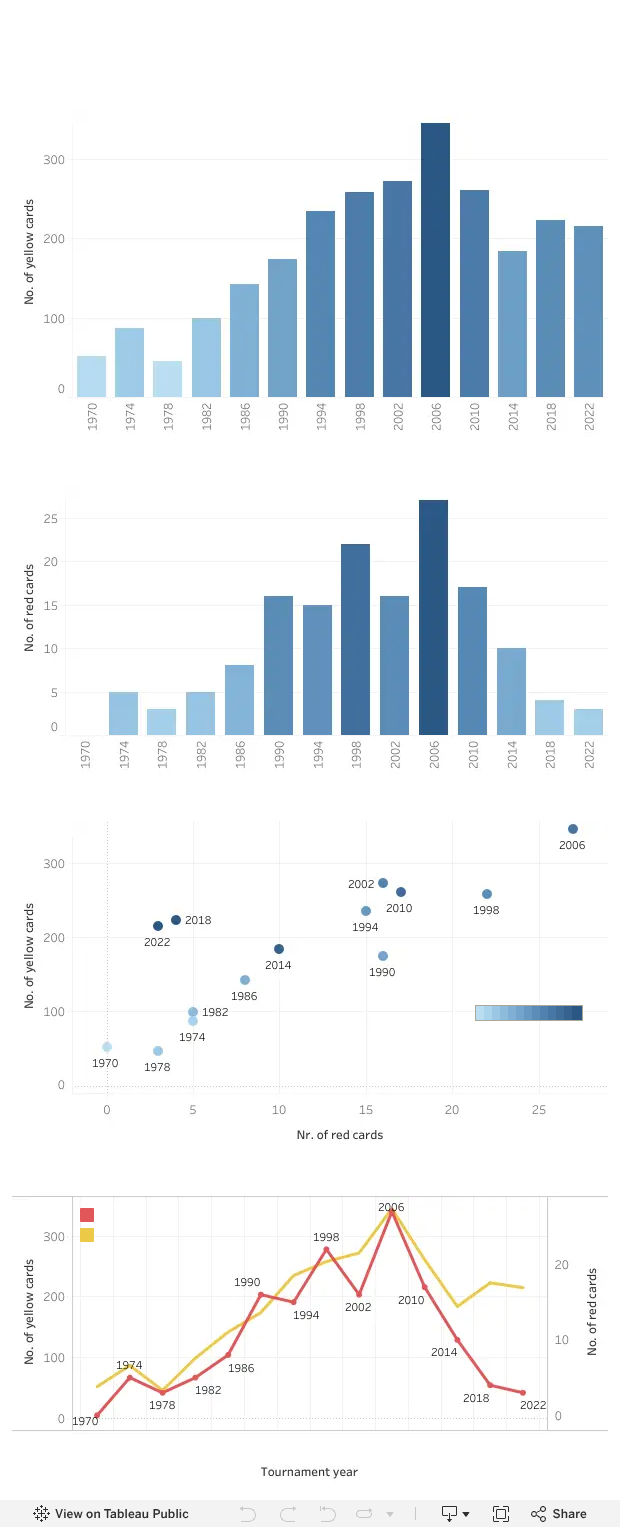
First of all, if we look at the general overview, we can see that the number of total cards given has increased steadily until 2006, a point of no return after which the trend shifted due to a clear change of mindset and directives. Additionally, the yellow card vs red card plot and comparison line chart both show a clear correlation between yellow and red cards until 2014, both either went up or down together, more or less, while in 2018 and 2022 the number of red cards reduced dramatically, and did not follow the yellow card trend line anymore. I can bet one of the explanations can be found in the introduction of VAR, reducing the number of violent conducts and making dirty play easier to catch and thus way riskier, but I am open to other hypothesis and opinions on this.
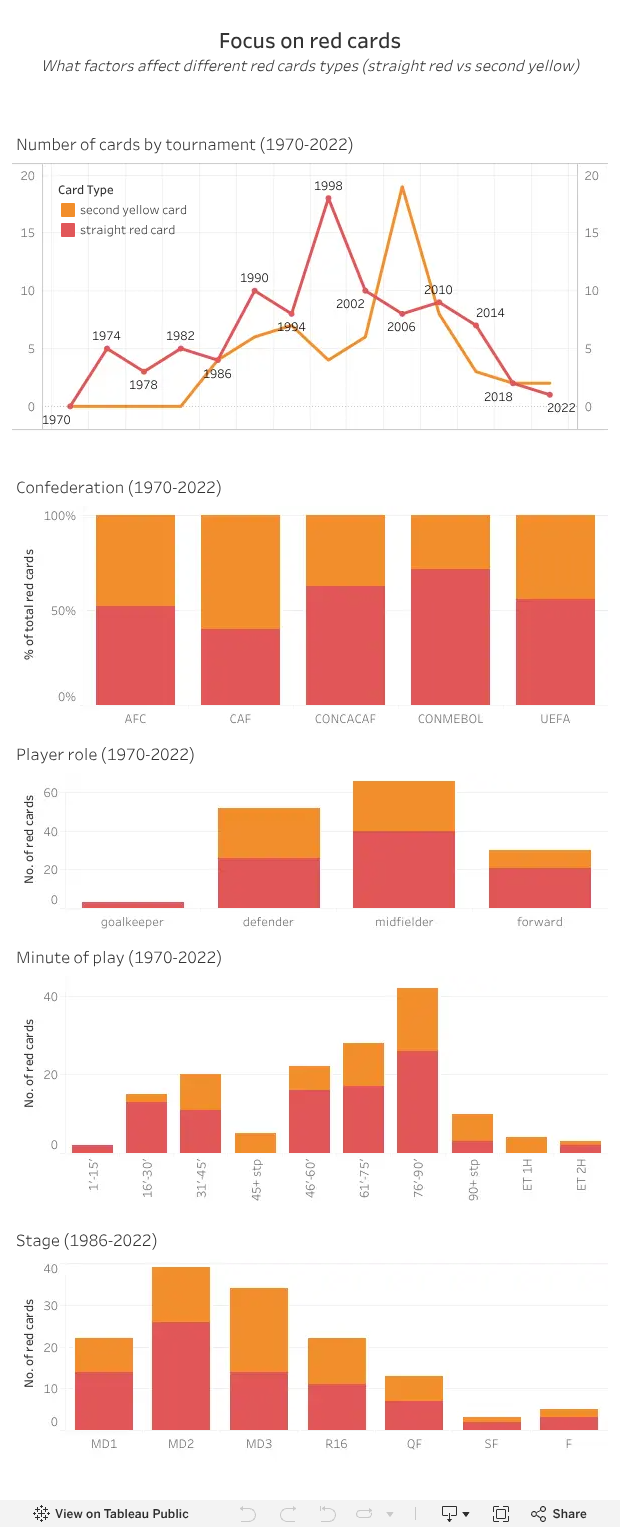
If we look at confederations, CONMEBOL is the one where most red cards are straight reds in proportion to the total red cards, followed by CONCACAF, while CAF is on the opposite side, with most red cards being second yellows. UEFA and AFC are sort of in-between. (Note: Australia has been listed in AFC even though before 2006 it was part of OFC, for simplicity).
In terms of player roles, nothing surprising, midfielders take most red cards followed by defenders. Interestingly, most of red cards given to strikers are straight red cards. No goalkeeper has ever been sent off for double caution; will this ever be the case?
When looking at minutes of play, no surprise the percentage of second yellow cards increases throughout the game, but we also notice that a vast majority of red cards given during stoppage time are a second yellow card. Most straight red cards seem to happen during regulation time, instead.
Finally, the chart I find most interesting is the one looking at stages – for this reason we only consider from 1986 onwards instead of 1970, in this case, as the stages were different before. Here we see that matchday 2 is the most challenging in terms of red cards, followed by matchday 3, while matchday 1 seems to be easier. The decrease then is normal from Round of 16 onwards, the number of games reduces, but the final is an exception! Much more players have been sent off in the main final than in the semis, and no player has ever been sent off in a 3rd place game since 1986 – there will be another chart on this topic in the next episode!
We can also look at cards during specific game periods, here we notice that the increase of average added time has also made yellow and red cards more frequent during stoppage time, just look at 2018 and 2022’s dark blue bar. What also strikes me is the 2006 bar in Red cards by period and event, there were more red cards given during 1st half stoppage time (4) than the entire first 45 minutes of play (3)!. As said earlier, we see a significant reduction in red cards in 2018 and 2022.
In the other three charts you can play around with the filter and look at the distribution of cards (all, yellow only, or red only) divided by stage, player role and confederation of the referee. Interestingly, there is no significant difference across different referee confederations in the distribution of cards during the game.

For the true nerds, I have further narrowed down the phases of the game to 15-minute intervals, so you can see how cards are distributed across smaller periods of time within a game. Again, the “Card color” filter allows you to only look at yellow cards or red cards, or both together.

The last block looks at how average card minutes have changed over time and confederation. In the first table, the number indicates the average minute of any card given during World Cup games, divided by tournament and the referee’s confederation.
The second table, similarly, only looks at the average minute of the first card given in each game.
As we expect, knowing what guidelines were given to referees in 2014 to delay as much as possible cautions in the first 30 minutes, the change from 2014 onwards is significant, and there wasn’t any real re-adjusting since.
In particular, if we look at the average first card of the game, CONMEBOL referees seem to have been the most affected ones, those who applied FIFA’s directives most strictly in 2014. While CONMEBOL referees gave their opening card on average after 30 minutes in 2010, the average first card in 2014 was at minute 51, and all confederations considered, the average minute for the card opening has shifted of 13 minutes compared to the previous edition!
The final two plots show the same results in a more visually compelling way.
The numbers that you see in the plot refer to the average minute of play, with cards given during extra time having been removed from the analysis for statistic reasons, and those given in added time having been set to minute 45 or 90 depending on the game half they occurred.


OT: Hope that Omar Artan will officiate at least at one WC match in Canada or Mexico after everything that happened to him.
ReplyDeleteOmar situation resolved or not
ReplyDeleteOmar Artan has been scrapped off the WC list and its final so are we expecting a replacement or not.
ReplyDeleteIf possible should it be CAF or someone with a missed opportunity //Siebert Scharer//
Chapter 2 all praises to the admins, by the end of these chapters I will a expert in FIFA refereeing Dynamics, thanks a lot.
DeleteThere are only 37 referees who actually will be used for World Cup matches: AFC = 4, CAF = 4, CONCACAF = 6, CONMEBOL = 8, UEFA = 15.
ReplyDeleteAlthough UEFA was chosen with the most referees selected (England and France with 2 crews each), it's the MLS on top with 3 referee crews selected.
These crews havea good chance to officiate at least 2 matches each during group play.