We are pleased to present a feature prepared by our reader Emmanuel, a journey through some unusual statistics ahead of the World Cup, which is about to begin.

In this first we will have a look at how appointments were made across confederations, what the required ‘experience’ to be appointed in the knock-out stages was and how the burning topic of confederation neutrality was handled in the latest editions.
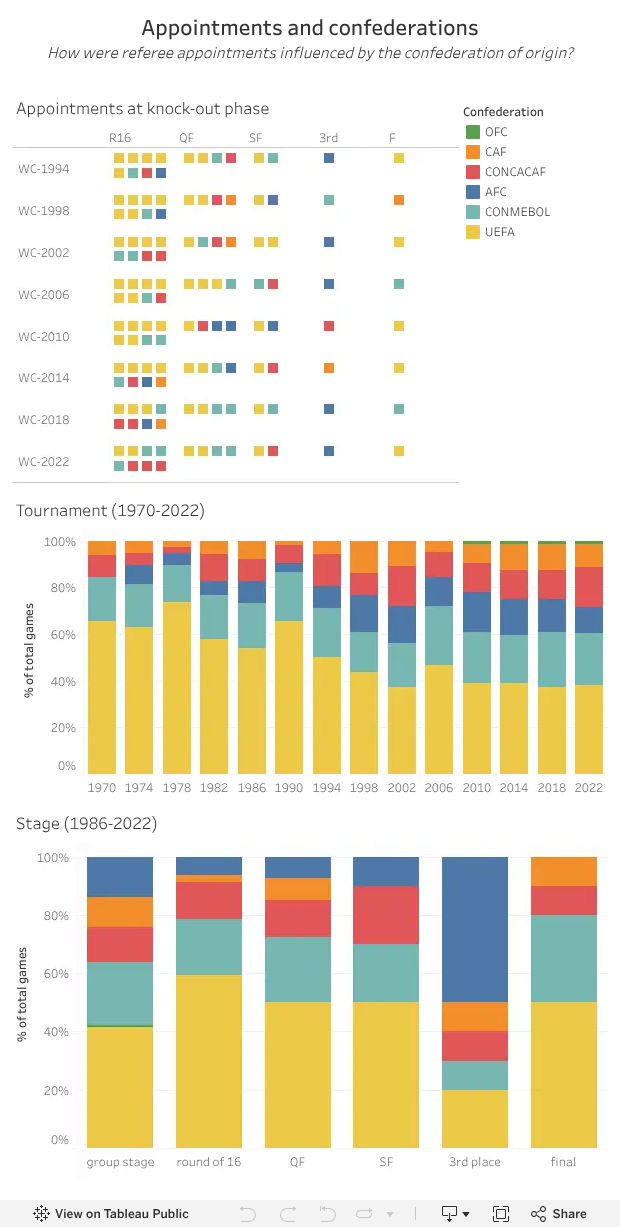
The visual focuses on the composition of the appointments by confederation. If we look at the bottom bar chart showing composition by tournament, we see how from 1970 the proportion of UEFA referees has been constantly decreasing until 2002. Afterwards it has been pretty much steady until 2022, with the exception of 2006, where the aftermath of the 2002 controversies seems to have pushed committee to appoint referees from a reduced pool and predominantly coming from the confederations that had the strongest power and reputation. In that edition UEFA and CONMEBOL referees were over-represented compared to all other World Cups of the new millennium. There has also been steady practice since 2010 to include an OFC referee to handle one game at group stage.
If we look at appointments by stage since 1986 – until 1982 the format was different and cannot be easily compared – we notice how UEFA and CONMEBOL together make up over 60% of group stage games and about 75% of the appointments at knock-out stage, with the exception of the 3rd place game, which has been assigned to an AFC referee in 50% of cases since 1986.
The Appointments at knock-out phase chart shows the individual games at knock-out stages since 1994 and individually labels each game with the color of the referee confederation. Most of you will be able to remember the names without even checking the labels!
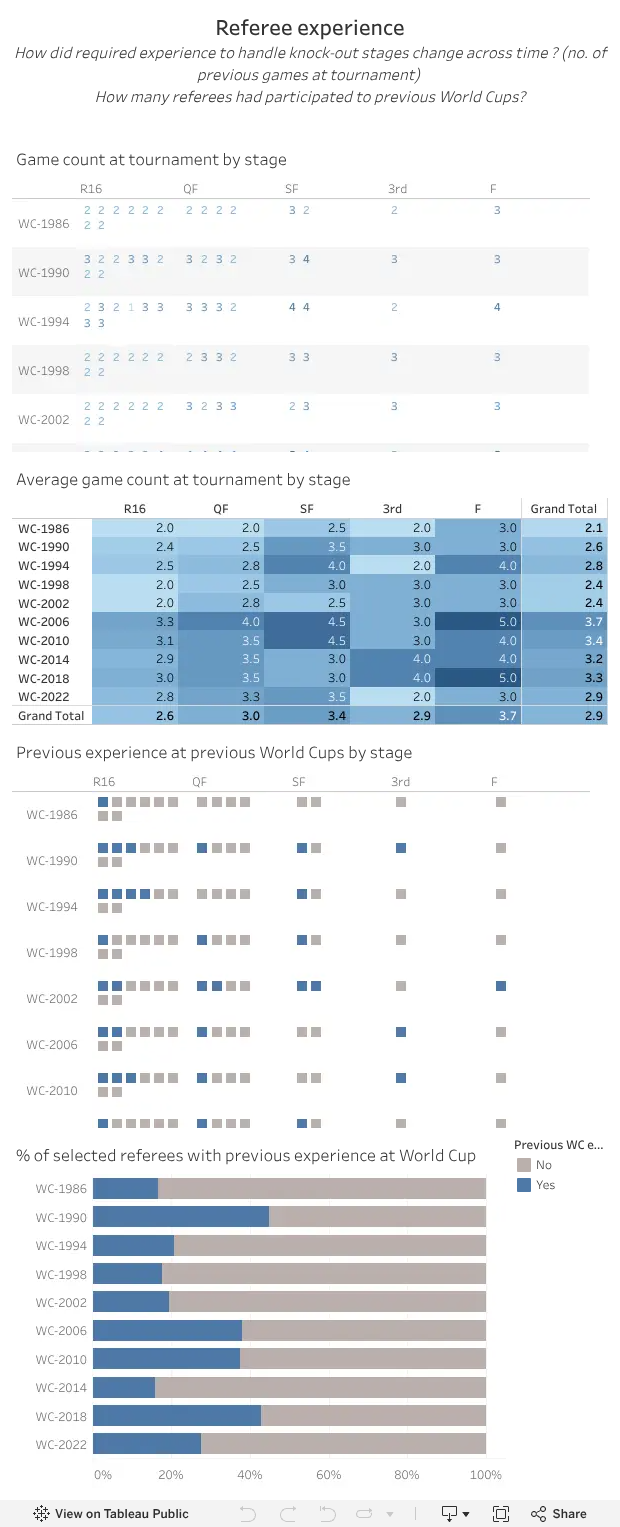
When talking about referee experience strictly at World Cup games, the simplest indicators are two: the number of games refereed at the same competition and the total number of games handled at World Cup, including previous editions.
The first table Game count at tournament by stage shows the game count for each referee appointment at the tournament once they reached that specific game. As example, in the 2022 Round of 16 all referees had already 2 games during the group stage, with the exception of two that only had one. One of them is S. Marciniak, who was later appointed for the final as his 3rd game of the tournament. Both N. Pitana in 2018 and H. Elizondo in 2006 got their final as 5th game at the tournament, while it is equally remarkable that B. Archundia in 2006 and R. Irmatov in 2010 handled a semi-final after 4 previous games at the same tournament.
Looking at this chart, it seems that after significantly increasing the number of games required to handle KO stage games in 2006, FIFA has reduced the number of appointments needed, getting closer to pre-2006 level again. The reason could be reducing the chances of incidents and controversies for the referees that are projected for the final stages, somehow protecting them, or maybe it was simply assessed as too much on a physical perspective to handle up to 5 games within a few weeks, significantly impacting the referee’s fitness in the final games. We will see how this will change at 2026 World Cup with the introduction of one extra stage at knock-out phase, with 16 referees needed to handle Round of 32 games.
In Average game count at tournament by stage we see the same information summarized by tournament and stage, again we see the clear change in color between 2002 and 2006, and the average number of games handled by referees at KO stage gradually decreasing again from 2006 to 2022. We also see how the peculiar appointment of the 3rd place game to a referee with only one previous game in 2022, has two precedents in 1986 and 1994.
The other two charts on the right side focus on the presence of the appointed referees at previous world cups. We can see that in recent times, 2014 was the tournament with least referees with previous World Cup games – over 80% were at their debut while only about 55% in 2018 and 1990. This is also reflected in the appointments, for instance all 4 referees at quarter final in 2018 had participated to 2014 World Cup. We also notice that the two latest finalists were a ‘safe pair of hands’ for FIFA, having refereed already 8 games (N. Pitana) and 4 games (S. Marciniak) before their final appointment, across two tournaments. This only happened once more in recent times to a certain P. Collina, who handled the 2002 final after being selected in 1998 as well.
Additional note: this section has considered “previous World Cup experience” only as being appointed as main referee in a previous World Cup game. Presence as selected referee without being appointed as main (e.g. 4th official or additional assistant referee) was not included.
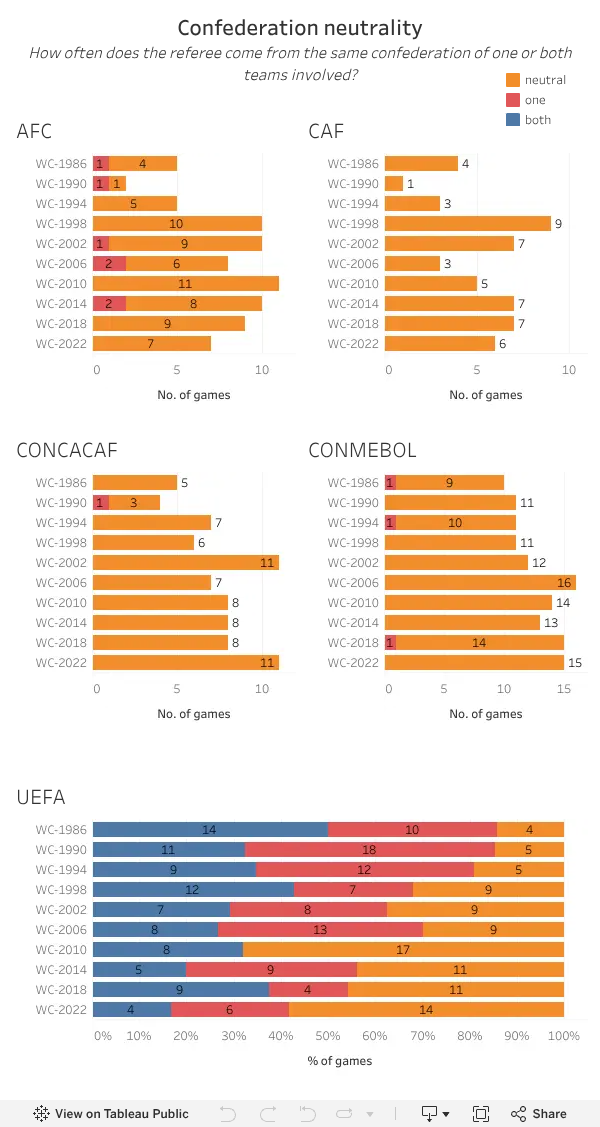
Finally, let’s dig into the confederation neutrality topic, which has been discussed several times on the blog. The charts are pretty self-explanatory: while confederation neutrality was regularly broken with UEFA officials, it rarely was the case with any other confederation. Never in CAF and only once in CONCACAF (E. Codesal from Mexico handled Italy-USA at group stage in 1990), it was broken three times in CONMEBOL in the past 10 World Cup tournaments. In 1986, R. Filho from Brazil refereed the final between West Germany and Argentina, in 1994 J. Cadena from Colombia handled a semi-final between Brazil and Sweden, while more recently in 2018 the Argentinian N. Pitana was in charge of a quarter-final involving Uruguay against France.
The matter is somehow more complex with AFC, since before 2010 Australian referees were part of OFC instead of AFC but for the scope of this analysis I included Australia as part of AFC, which impacts on confederation neutrality. However, there are still cases of proper AFC referees appointed to other AFC teams. The implicit rule seems to be to avoid referees from the same geographical area but to allow other combinations, such as referees from Far Eastern countries allowed to referee teams from Middle Eastern countries and vice versa.
Below is the complete list of broken neutrality in AFC:
1986: South Korea – Bulgaria (F. Al-Shanar, Saudi Arabia, group stage)
1990: Yugoslavia – United Arab Emirates (S. Takada, Japan, group stage)
2002: South Korea – Turkey (S. Al-Fadhli, UAE, 3rd place)
** Australia listed as OFC at the time **
2006: Iran – Angola (M. Shield, Australia, group stage)
2006: Tunisia – Saudi Arabia (M. Shield, Australia, group stage)
2014: Australia – Spain (N. Shukralla, Bahrain, group stage)
2014: South Korea – Belgium (B. Williams, Australia, group stage)
As for UEFA, we look at data in % of total games instead of the absolute values, since we have a much bigger pool of games compared to any other confederation. Some of you will already know that FIFA committed to avoiding one-sided confederation neutrality in 2010, meaning that UEFA referees were only appointed to UEFA teams if both of them belonged to the UEFA area. Basically, they were only allowed to referee UEFA vs UEFA teams or non-UEFA vs non-UEFA teams and never a UEFA vs non-UEFA team clash. This was not the case in any other tournament since 1986. In 2022 the number of games (10) where neutrality was broken was less than in 2018 (13) and 2014 (14), we will see what will happen in 2026, but with more games to be played and a higher proportion of non-UEFA teams compared to previous tournaments I would expect that FIFA will break confederation neutrality less frequently this year.

Amazing work by the blog ! Congratulations Chefren !
ReplyDelete+1 absolutely brilliant for some of us are juniors so this greatly appreciated. Thanks all the efforts
Delete+1 A thoroughly enjoyable and informative read
DeleteThat's great! Thanks!
DeleteWill we be able to submit our predictions this year
ReplyDeleteFor all predictions, I can invite to join the site:
Deletehttps://whatref.com/
Somehow, either the values or the lengths of the bars do not always match - example: Confederation neutrality:
ReplyDeleteCAF 1986: 4, but the bar only reaches 3.
CONCACAF 1986: 5, but the bar only reaches 4.
CONCACAF 2002: 11, but the bar only reaches 10.
CONCACAF 2022: 11, but the bar only reaches 10.
CONMEBOL 1986+1990: 10 (1+9) and 11 are the same length, but according to the axis label each is only 9.
CONMEBOL 2022: 15, but the bar only reaches 14.
Have a place for video clips posted since there are so many matches. Like a page just for video links of controversial or important decisions from each match. With no comments about them. So we don't need to scroll and try to find the links.
ReplyDeleteWe are a referee forum, not a video hosting platform. It really isn't that difficult, with respect, for anybody under the age of thirty to learn how to download matches and cut videos to upload for social media. I would suggest you take the time to do that, rather than be consistently unthankful on here. And there is always reddit soccer...
DeleteWait a second. The whole thing about this blog is to discuss match situations. There will be plenty of them for every match. When on earth was I unthankful here. Don't mix up who you are commenting to and be less arrogant.
DeleteI am very happy to announce a project for the upcoming World Cup - a dedicated Telegram group to discuss refereeing matters. The link to the group is below:
ReplyDeletehttps://t.me/wc26refs
I think it is no secret that the overall level of discussion on the blog decreases quite significantly during major tournaments, and so I think it is a good time to try this small experiment, which was probably due now for quite a long time. My idea is that many problems of the blogger format are easily alleviated there - the mass creation of duplicate accounts, an inability to ban users who write inane comments (such as comment no1 on the CL final discussion post, for example).
The intention would be to open a new page for each day of matches, and maintain a couple of general pages there too. I think the group format also lends itself to better and more detailed discussions than are possible in the comments of a blogger page; at least, that would be my hope. I have no idea how it will turn out, but I’m quite excited about the project - having a blog format indeed made a lot of sense in 2011, but fifteen years later, I think there is no shame in admitting that the nature of the internet has changed quite a lot, and admit a need to try a slightly different approach.
So: I would invite regular Law5 contributors and silent readers alike to join us there!
The group will be operational from tomorrow morning.
An excellent idea! Looking forward to being in the group
DeleteGreat idea! I'll defenitely join
DeleteFantastic! Thanks
DeleteWhy Telegram? If you think a blog on web is outdated, better make a Discord server in 2026. But Telegram, that has such a controversial reputation, is an odd choice.
DeleteLooks like there is some hesitation to Telegram...May I suggest a WhatsApp group chat or community. A more trusted platform with the ability to run polls for opinions on decisions
DeleteI’m not a fan of Telegram and won’t be signing up there. Will the posts—and the discussion comments—be visible on this site as well?
ReplyDeleteAnd where can the referee appointments be viewed?
ReplyDeleteI don't think the creation of this ad-hoc Telegram group for the WC means the blog will stop running and publishing appointments and discussion pages
DeletePrediction for opening match referee?
ReplyDeleteOliver or Marciniak
DeleteOliver for opening, Elfath for the last one
DeleteMarciniak
DeleteMarciniak
ReplyDeleteI gut keeps telling me Taylor is the leading candidate for a reason of some compensation for the Qatar world cup 22 because if I'm mistaken he was among the referees' who finished the all tournament but he didn't get a single match of the last 4 games and with his age, this can be his last crowning moment.
ReplyDeleteMy gut. Sorry for the inconveniences
DeleteYes, but one can say that he was already compensated during the Club-WC. The sonorous QF match between PSG and Bayern was more than anyone expected after 0 UCL KO matches.
DeleteOn the other hand, since recall a very good performance, Taylor might have earned trust.
Generally very interesting to see how the two English will be managed, since Oliver is in great form and coming from a WC22 QF. Probably a lot is dependent on Thomas Tuchels Team.
This comment has been removed by the author.
ReplyDelete